


Uptake Assay of Ram Seminal Plasma Extracellular Vesicles to Sperm
公羊精浆来源细胞外囊泡在精子中的摄取检测方法

发布: 2026年04月05日第16卷第7期 DOI: 10.21769/BioProtoc.5653 浏览次数: 382
 PDF
PDF  Q&A
Q&A
参见作者原研究论文
The authors used this protocol in:

Feb 2026
Advertisement






Abstract
Extracellular vesicles (EVs) are critical mediators of cell–cell communication and play a key role in male reproductive biology by modulating sperm function. This protocol describes a robust and reproducible workflow for isolating EVs from ram seminal plasma using size-exclusion chromatography (SEC) and assessing their uptake by ram spermatozoa. In contrast to ultracentrifugation-based methods, SEC provides a gentle and more efficient isolation approach that preserves EV integrity and functionality. A central innovation of this protocol is the use of carboxyfluorescein succinimidyl ester (CFSE)-labeled seminal plasma EVs (SP-EVs) to evaluate their incorporation into sperm cells through two complementary detection platforms: (i) flow cytometry with standard resolution and (ii) confocal microscopy, for spatial confirmation of EV–sperm interactions. By bridging the gap between EV isolation and functional analysis, this protocol provides a valuable tool for investigating the role of EV–cell interactions. Specifically, it offers potential applications in male fertility preservation, biomarker discovery, and the development of EV-based therapeutic strategies in reproductive medicine.
Key features
• Provides a gentle, SEC-based EV isolation method optimized for ram seminal plasma, suitable for preserving vesicle integrity in studies of male reproductive biology.
• Integrates EV purification with functional assays, enabling direct evaluation of EV–sperm interactions through confocal microscopy and flow cytometry.
• Includes a reproducible CFSE-labeling strategy tailored for seminal plasma EVs, ensuring consistent detection of vesicle uptake by ram spermatozoa.
• Designed for applications in fertility research, offering a workflow compatible with biomarker discovery, cryopreservation studies, and development of EV-based reproductive interventions.
Keywords: Extracellular vesicles (细胞外囊泡) Seminal plasma (精浆)
Sperm (精子)
Size-exclusion chromatography (尺寸排阻色谱)
CFSE (CFSE染料)
Flow cytometry (流式细胞术)
Seminal plasma (精浆)
Sperm (精子)
Size-exclusion chromatography (尺寸排阻色谱)
CFSE (CFSE染料)
Flow cytometry (流式细胞术)
Graphical overview
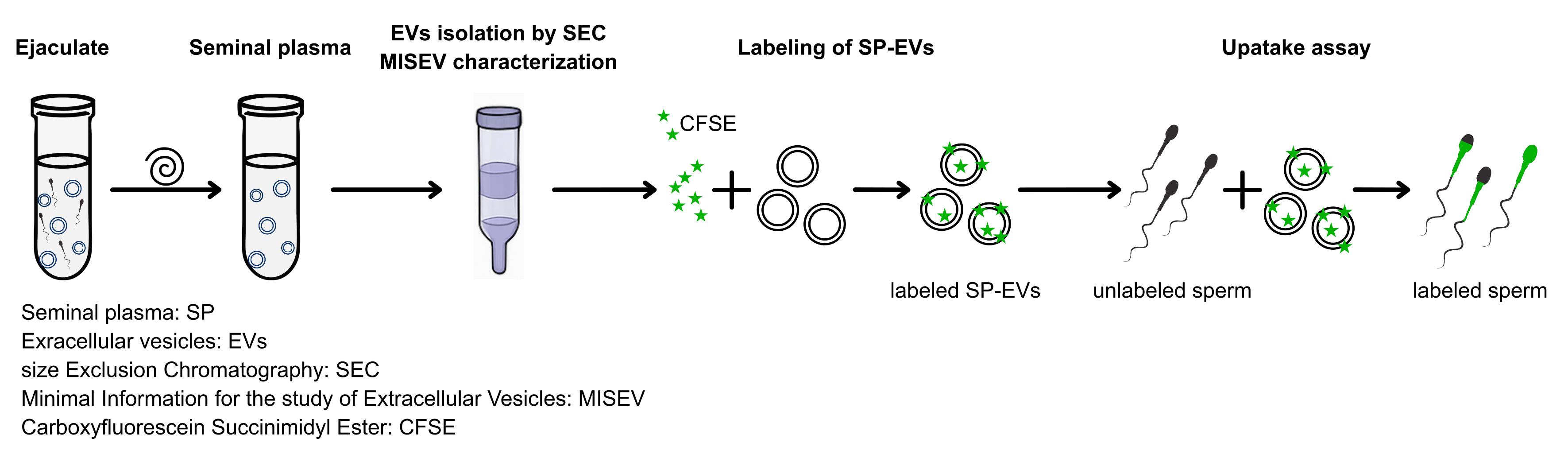
Extracellular vesicles uptake assay by CFSE labeling
Background
Extracellular vesicles (EVs) are membrane-bound particles present in all biological fluids that act as key mediators of intercellular communication [1]. By transporting proteins, lipids, and nucleic acids, they regulate a wide range of cellular processes [1–3]. In reproductive biology, EVs derived from seminal plasma have gained prominence as pivotal regulators of sperm function, exerting influence on processes including motility, capacitation, and fertilization [4–8]. Additionally, EVs from seminal plasma have also been demonstrated to have a subsequent impact on preimplantation, implantation, post-implantation, and pregnancy-associated diseases, as well as on seminal infections [9]. However, despite their relevance, progress in this field has been limited due to methodological variability and lack of standardized, reproducible assays for assessing EV–sperm interactions at the molecular level [10,11].
To address this gap, the present protocol provides an integrated workflow that goes beyond EV isolation and introduces a robust assay to evaluate the uptake of carboxyfluorescein succinimidyl ester (CFSE)-labeled seminal plasma EVs by ram spermatozoa. The key innovation lies in the labeling of seminal plasma (SP)-EVs with CFSE, their co-incubation with sperm cells, and the subsequent detection of vesicle internalization. While EV identity is validated through standard characterization methods—transmission electron microscopy (TEM) and nanoparticle tracking analysis (NTA)—all subsequent steps of the uptake assay can be performed in a conventional laboratory equipped with basic flow cytometry and fluorescence microscopy.
The potential applications of this protocol are manifold for fundamental research on EV–cell interactions in male infertility. This protocol aims to advance the field by providing a reliable tool for studying EVs in reproductive biology and beyond.
Materials and reagents
Biological materials
1. Ram semen samples
2. Semen straws
Reagents
1. Phosphate-buffered saline (PBS) (Gibco, catalog number: 10010049)
2. Primary antibodies: anti-CD9 (1:1000, Sigma-Aldrich, catalog number: A4Y16), anti-CD63 (1:2,000, Cell Signal, catalog number: 55051), anti-HSP70 (1:1,000, Sigma-Aldrich, catalog number: SAB420071), anti-CNX (1:1,000, Abcam, catalog number: ab22595), and anti-ApoC3 (1:3,000, Invitrogen, catalog number: PA5-114865)
3. Secondary antibodies: anti-mouse IgG-HRP conjugated (1:10,000, Sigma-Aldrich, catalog number: A4Y16) and anti-rabbit IgG-HRP conjugated (1:10,000, Sigma-Aldrich, catalog number: A615Y)
4. Dextran blue solution (1 mg/mL in PBS) (Sigma-Aldrich, catalog number: D5751)
5. Sperm selection density gradient (e.g., Ovipure, Nidacon Laboratories AB, Göthenborg, Sweden; or Percoll, Sigma-Aldrich, catalog number: P4937)
6. CellTrace CFSE Cell Proliferation kit (Thermo Fisher Scientific, catalog number: C34554 A); contains dimethyl sulfoxide (DMSO)
7. 10% and 15% SDS-PAGE pre-cast gels (Bio-Rad, catalog number: 456-8033)
8. Ethanol (Sigma-Aldrich, catalog number: 51976)
Laboratory supplies
1. Pipettes (any brand)
2. Tubes (Eppendorf, catalog number: 0030120086)
3. Ultracentrifuge tubes (Beckman Coulter, catalog number: 355631)
4. SuperdexTM 200 column (Cytiva, formerly Amersham Pharmacia, catalog number: 17-1043-01)
5. 0.22 μm filters (Millipore, catalog number: SLGP033RS)
6. PVDF membrane (Millipore, catalog number: IPVH00010)
7. Neubauer chamber (Boeco, Germany)
8. Microscope slides (Thermo Fisher, catalog number: 9951B9)
Equipment
1. Centrifuge (Eppendorf, model: 5810 R)
2. Ultracentrifuge (Beckman Coulter, model: Optima LE-80k)
3. Rotor type 90 Ti (Beckman Coulter, catalog number: 355530)
4. Spectrophotometer (Nanodrop One Thermo Fisher Scientific, catalog number: ND-ONE-W)
5. Flow cytometer (any brand)
6. Confocal microscope (any brand)
7. Water bath (any brand)
8. Heating block (any brand)
9. Rotating mixer (any brand)
10. pH meter (any brand)
11. Gel electrophoresis vertical apparatus (any brand)
12. Semi-dry protein gel transfer system (for gels up to 9 × 6 cm, any brand/model)
13. Chemiluminescence scanner (LI-COR)
14. SEC column stand/rack
15. Peristaltic pump (any brand) (optional)
Software and datasets
1. Licor C-Digit chemiluminescence scanner version 5.2.0
2. GraphPad Prism version 8.0.2
3. RStudio version 3.3.3
4. ImageJ (https://imagej.nih.gov/ij/)
5. Flow cytometry software
Procedure
登录/注册后免费查看全文
文章信息
稿件历史记录
提交日期: Jan 10, 2026
接收日期: Mar 2, 2026
在线发布日期: Mar 26, 2026
出版日期: Apr 5, 2026
版权信息
© 2026 The Author(s); This is an open access article under the CC BY-NC license (https://creativecommons.org/licenses/by-nc/4.0/).
如何引用
Armani, T., Nicolli, A. R., Zalazar, L., Lobo, J. I., Arellano, M. B., Hozbor, F. A., Rio, S., Martinez, S. P. and Cesari, A. (2026). Uptake Assay of Ram Seminal Plasma Extracellular Vesicles to Sperm. Bio-protocol 16(7): e5653. DOI: 10.21769/BioProtoc.5653.

 Download Citation in RIS Format
分类
发育生物学 > 繁殖
细胞生物学 > 细胞器分离 > 胞外囊泡
细胞生物学 > 基于细胞的分析方法 > 细胞间的相互作用
您对这篇实验方案有问题吗?
在此处发布您的问题,我们将邀请本文作者来回答。同时,我们会将您的问题发布到Bio-protocol Exchange,以便寻求社区成员的帮助。
 发布问题
发布问题


