


Workflow for Crystallographic Fragment Screening by Crystal Soaking for Protein Targets: A Case Study on Thioredoxin Glutathione Reductase From Schistosoma mansoni
基于晶体浸泡的蛋白靶点晶体学片段筛选流程:以曼氏血吸虫硫氧还蛋白-谷胱甘肽还原酶为例

发布: 2026年04月20日第16卷第8期 DOI: 10.21769/BioProtoc.5651 浏览次数: 793
评审: Joana Alexandra Costa ReisVandana MishraAnonymous reviewer(s)
 PDF
PDF  Q&A
Q&A
参见作者原研究论文
The authors used this protocol in:

Jan 2024
Advertisement




Abstract
Among the biophysical techniques used in fragment-based drug discovery (FBDD) campaigns, crystallography is the most sensitive, allowing for the identification of low-affinity ligands and the characterization of protein–ligand complexes at atomic resolution. Although powerful, the proper application of this technique depends on obtaining crystals capable of diffracting X-rays at high resolution. Additionally, in crystallographic compound screening, the crystals must be resistant to multiple organic solvents used in chemical libraries, such as DMSO. In this protocol, we describe recombinant protein production suitable for crystallization and procedures for X-ray crystallographic screening of a library of 768 fragments. As a case study, we used the Schistosoma mansoni thioredoxin glutathione reductase (SmTGR), a redox enzyme with a key role in controlling oxidative stress in parasites of the Schistosoma genus, which causes schistosomiasis. As a validated pharmacological target, SmTGR is used in the development of new schistosomicidal drugs. The experimental pipeline includes SmTGR expression, purification, and crystallization, crystal soaking, diffraction data collection, and refinement. The 768 fragments from the Diamond-SGC Poised Library (DSPL) were individually soaked onto the crystals, and diffraction data were collected and processed at the I04-1 beamline of the Diamond Light Source synchrotron. Diffraction data were subsequently analyzed using PanDDA to identify fragment-binding events and to enable reliable detection of low-occupancy ligands within the protein crystal structures. In addition to the core experimental steps, this protocol incorporates systematic approaches to overcome limitations frequently encountered in crystallographic screening campaigns, including assessment of crystal solvent tolerance, acceleration of crystal mounting through the use of auxiliary devices, acoustic dispensing–based soaking of hundreds of fragments for low material consumption and high throughput, automated data collection, and efficient data analysis pipeline for the detection of weakly bound ligand. This protocol can be broadly applied to screen diverse compound sets against multiple targets amenable to crystallization.
Key features
• Obtaining SmTGR through expression in ExpiSf9 cells with proper yield and purity for crystallization assays.
• Systematic testing of buffer solutions to determine crystallization conditions, assessment of crystal tolerance to DMSO, and crystallographic data collection.
• Integration of crystallization, acoustic dispensing, shifter-aided crystal mounting, data collection, and analysis powered by an in-house software pipeline.
• This protocol builds upon the method developed by [1] and extends its application to other soluble proteins.
Keywords: SmTGR (SmTGR) Protein production (蛋白表达与制备)
Acoustic dispensing (声学分液)
Soaking (晶体浸泡)
Crystallography (晶体学分析)
Fragment (片段筛选)
Drug discovery (药物发现)
XChem (XChem平台)
Protein production (蛋白表达与制备)
Acoustic dispensing (声学分液)
Soaking (晶体浸泡)
Crystallography (晶体学分析)
Fragment (片段筛选)
Drug discovery (药物发现)
XChem (XChem平台)
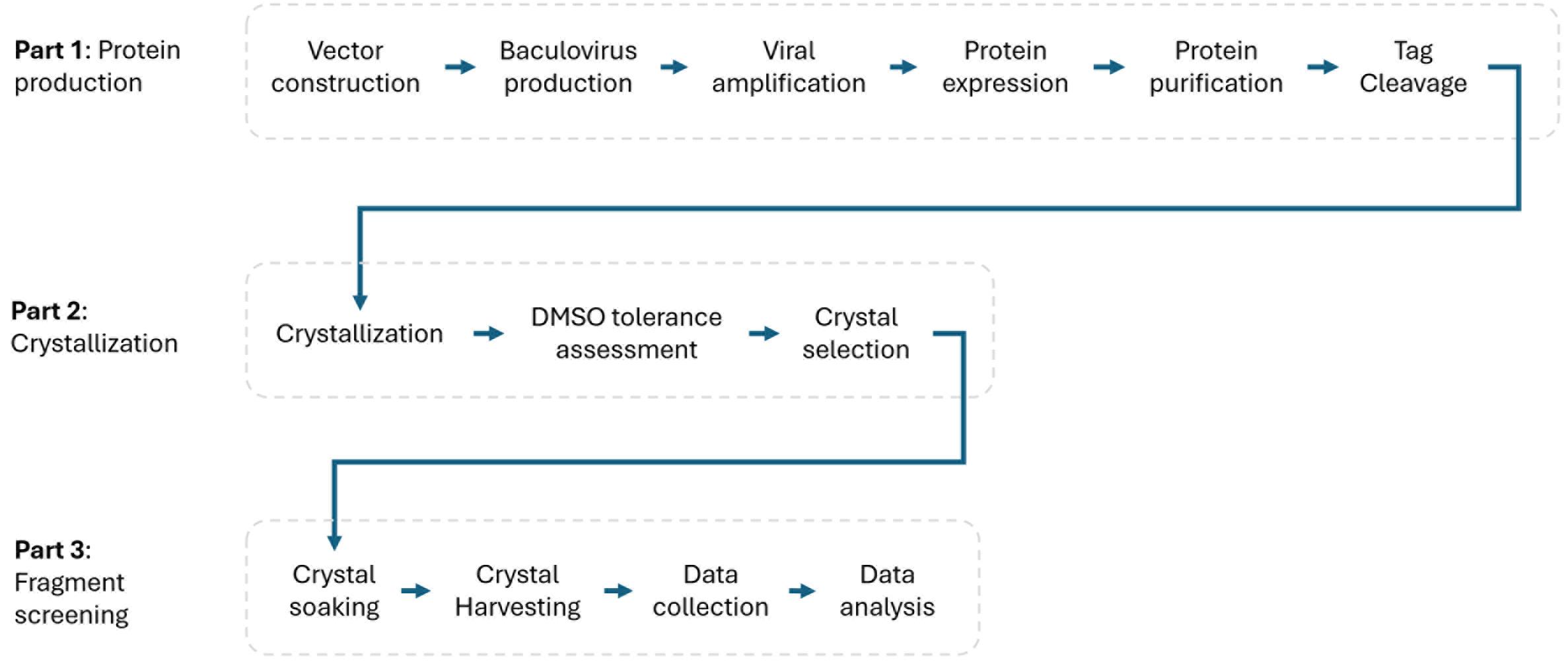
Graphical overview
Background
Recently, fragment-based drug discovery (FBDD) has gained prominence as a robust approach for drug development. Novel experimental setups have streamlined several stages of the process, accelerated workflows, and enhanced result throughput. When combined with advanced biophysical techniques such as X-ray crystallography, this method enables the identification of low-affinity ligands and facilitates detailed characterization of protein–ligand interactions at atomic resolution, which is essential for the rational design of new therapeutics [2].
Various methodologies have been employed in FBDD, including high-throughput screening and structure-based drug design [3]. However, the crystallography-based approach is particularly distinguished by its unique sensitivity to detect low-affinity ligands, such as fragments. Our protocol presents a comprehensive pipeline encompassing vector construction, baculovirus production, expression, purification, and crystallization of the target protein, followed by crystallographic screening of a small (near 800 compounds) fragment library. This systematic approach significantly accelerates the acquisition of high-quality crystals suitable for X-ray diffraction, which is crucial for identifying potential inhibitors. Moreover, in addition to the prerequisite of obtaining enough high-quality crystals, access to a synchrotron light source and to the integrated computational pipeline described herein are essential for the successful application of this protocol.
The targeting of Schistosoma mansoni thioredoxin glutathione reductase (SmTGR) is crucial in the search for effective treatments against schistosomiasis, a parasitic disease that affects millions globally. SmTGR is a redox enzyme that plays a vital role in managing oxidative stress within parasites, and it has emerged as a validated pharmacological target for developing new schistosomicidal drugs [4]. While crystallography offers detailed structural insights, it can be time-consuming and requires substantial expertise. Nonetheless, this protocol not only advances our understanding of SmTGR but also holds promise for investigating crystallizable protein targets across diverse contexts, thereby expanding its applicability in the field of drug discovery.
Materials and reagents
Biological materials
1. ExpiSf9 cells (Gibco, catalog number: A35243)
2. Escherichia coli StellarTM competent cells (Takara Bio, catalog number: 636763)
3. Diamond-SGC Poised Library (DSPL) (https://www.diamond.ac.uk/Instruments/Mx/Fragment-Screening/Fragment-Libraries/DSPL.html)
Reagents
1. Agar (Sigma-Aldrich, catalog number: A6686)
2. Ampicillin (Sigma-Aldrich, catalog number: A9393)
3. Anti-histidine tag antibody (Merck, catalog number: SAB1306082)
4. Benzonase (Merck, catalog number: E1014-5KU)
5. BCS Crystallization Screen kit (Molecular Dimensions, catalog number: MD1-104)
6. Bsu36I (New England Biolabs, catalog number: R0524L)
7. CaCl2·2H2O (Sigma-Aldrich, catalog number: 223506)
8. Chloramphenicol (Sigma-Aldrich, catalog number: C0378)
9. Coomassie InstantBlue (Abcam, catalog number: ab119211)
10. Deionized water
11. DMSO (Sigma-Aldrich, catalog number: D2650)
12. Ethanol (Sigma-Aldrich, catalog number: 459844)
13. ExpiSf9 CD medium (Gibco, catalog number: A3767803)
14. Fetal bovine serum (FBS) (Thermo Fisher Scientific, catalog number: A2720801)
15. Fetal calf serum (FCS) (Sigma-Aldrich, catalog number: F1051)
16. FuGENE HD transfection reagent (Promega, catalog number: E2311)
17. Glucose (Sigma-Aldrich, catalog number: G7021)
18. Glycerol (Sigma-Aldrich, catalog number: 5516)
19. HCl (Sigma-Aldrich, catalog number: 258148)
20. HindIII (New England Biolabs, catalog number: R0104M)
21. HisTrap FF Ni-NTA columns, 5 mL (Cytiva, catalog number: 1752860)
22. Imidazole (Sigma-Aldrich, catalog number: I2399)
23. Imidazole (Sigma-Aldrich, catalog number: 1.04716)
24. In-Fusion HD Cloning kit (Takara Bio, catalog number: 102518)
25. Isopropanol (Sigma-Aldrich, catalog number: 190764)
26. JCSG-Plus Crystallization Screen kit (Molecular Dimensions, catalog number: MD1-37)
27. Kanamycin (Sigma-Aldrich, catalog number: K1377)
28. KCl (Sigma-Aldrich, catalog number: P5405)
29. KpnI (New England Biolabs, catalog number: R3142M)
30. Liquid nitrogen
31. Luria broth (LB) (Melford, catalog number: L24400)
32. MgCl2·6H2O (Sigma-Aldrich, catalog number: M9272)
33. Morpheus Crystallization Screen kit (Molecular Dimensions, catalog number: MDS1-46)
34. NaCl (Sigma-Aldrich, catalog number: S9888)
35. NaOH (Sigma-Aldrich, catalog number: 221465)
36. NEB Express Ni-NTA magnetic beads (New England Biolabs, catalog number: S1423L)
37. NEBufferTM 3 (New England Biolabs, catalog number: B7003S)
38. Nucleobond BAC 100 Kit (Macherey-Nagel, catalog number: 740579)
39. PEG 2000 (Sigma-Aldrich, catalog number: 8.14172)
40. PEG 3350 (Sigma-Aldrich, catalog number: 8.17045)
41. PEG 4000 (Sigma-Aldrich, catalog number: 8.07490)
42. PEG 5000 monomethyl ether (Sigma-Aldrich, catalog number: 17929)
43. PGA Crystallization Screen kit (Molecular Dimensions, catalog number: MD1-50)
44. PIPES (Sigma-Aldrich, catalog number: P6757)
45. pOPINS3C (Addgene, catalog number: 41115)
46. PierceTM HRV 3C Protease Solution kit (Thermo Fisher Scientific, catalog number: 88946)
47. Protease inhibitor cocktail (Sigma-Aldrich, catalog number: P8849)
48. PureYieldTM miniPlasmid Miniprep System (Promega, catalog number: A1223)
49. SG1 Crystallization Screen kit (Molecular Dimensions, catalog number: MD1-88)
50. SigmaMarker low-range molecular weight standard (Sigma, catalog number: M3913)
51. Swissci triple-drop crystallization plates (Molecular Dimensions, catalog number: MD11-003-100)
52. TCEP (Sigma-Aldrich, catalog number: C4706)
53. Tris base (Sigma-Aldrich, catalog number: T1503)
54. Trypan blue solution, 0.4% (Gibco, catalog number: 15250-061)
55. Tryptone (Merck, catalog number: T9410)
56. Tween-20 (Sigma-Aldrich, catalog number: 11332465001)
57. Yeast extract (Merck, catalog number: 92144)
Solutions
1. Washing buffer (see Recipes)
2. Lysis buffer (see Recipes)
3. Elution buffer (see Recipes)
4. Gel filtration buffer (see Recipes)
5. Crystallization buffer (BCS C12) (see Recipes)
6. 2 M MgCl2 solution (see Recipes)
7. Tris-EDTA buffer (see Recipes)
8. SOC medium (see Recipes)
9. Sterile KCl 250 mM (see Recipes)
10. Sterile NaOH 5 N (see Recipes)
11. Sterile glucose 1 M (see Recipes)
12. LB-agar medium (see Recipes)
Recipes
1. Washing buffer
| Reagent | Final concentration | Amount |
|---|---|---|
| Tris base | 50 mM | 6.06 g |
| HCl | n/a | As needed to adjust pH to 7.5 |
| NaCl | 500 mM | 29.22 g |
| Imidazole | 30 mM | 2.042 g |
| dH2O | n/a | 1,000 mL |
2. Lysis buffer
| Reagent | Final concentration | Amount |
|---|---|---|
| Tris base | 50 mM | 6.06 g |
| HCl | n/a | As needed to adjust pH to 7.5 |
| NaCl | 500 mM | 29.22 g |
| Imidazole | 30 mM | 2.04 g |
| Tween-20 | 0.2% | 2 mL |
| dH2O | n/a | 1,000 mL |
3. Elution buffer
| Reagent | Final concentration | Amount |
|---|---|---|
| Tris base | 50 mM | 6.06 g |
| HCl | n/a | As needed to adjust pH to 7.5 |
| NaCl | 500 mM | 29.22 g |
| Imidazole | 500 mM | 34.04 g |
| dH2O | n/a | 1,000 mL |
4. Gel filtration buffer
| Reagent | Final concentration | Amount |
|---|---|---|
| Tris base | 20 mM | 2.42 g |
| HCl | n/a | As needed to adjust pH to 7.5 |
| NaCl | 200 mM | 11.69 g |
| TCEP (optional) | 1 mM | 0.29 g |
| dH2O | n/a | 1,000 mL |
5. Crystallization buffer (BCS C12)
| Reagent | Final concentration | Amount |
|---|---|---|
| CaCl2.2H2O | 100 mM | 14.7 g |
| MgCl2.6H2O | 100 mM | 20.3 g |
| PIPES | 100 mM | 3.36 g |
| PEG 3350 | 5.625% (w/v) | 56.25 g |
| PEG 4000 | 5.625% (w/v) | 56.25 g |
| PEG 2000 | 5.625% (w/v) | 56.25 g |
| PEG 5000 monomethyl ether | 5.625% (w/v) | 56.25 g |
| dH2O | n/a | 1,000 mL |
6. 2 M MgCl2 solution
| Reagent | Final concentration | Amount |
|---|---|---|
| MgCl2.6H2O | 2 M | 40.1 g |
| dH2O | n/a | 100 mL |
7. Tris-EDTA buffer
| Reagent | Final concentration | Amount |
|---|---|---|
| Tris base | 100 mM | 1.21 g |
| EDTA | 10 mM | 0.29 g |
| dH2O | n/a | 1,000 mL |
8. SOC medium
| Reagent | Final concentration | Amount |
|---|---|---|
| Tryptone | 2% (w/v) | 20 g |
| Yeast extract | 0.5% (w/v) | 5 g |
| NaCl | 10 mM | 0.58 g |
| Glucose | 20 mM | 20 mL |
| KCl | 2.5 mM | 10 mL |
| NaOH | n/a | As needed to adjust pH to 7.4 |
| MgCl2 2 M | 10 mM | 5 mL |
| dH2O | n/a | 1,000 mL |
9. Sterile KCl 250 mM
| Reagent | Final concentration | Amount |
|---|---|---|
| KCl | 250 mM | 1.96 g |
| dH2O | n/a | 100 mL |
10. Sterile NaOH 5 N
| Reagent | Final concentration | Amount |
|---|---|---|
| NaOH | 5 N | 50 g |
| dH2O | n/a | 250 mL |
11. Sterile glucose 1 M
| Reagent | Final concentration | Amount |
|---|---|---|
| Glucose | 1 M | 18.02 g |
| dH2O | n/a | 100 mL |
12. LB-agar medium
| Reagent | Final concentration | Amount |
|---|---|---|
| Tryptone | 1% (w/v) | 10 g |
| Yeast extract | 0.5% (w/v) | 5 g |
| NaCl | 10 mM | 10 g |
| Agar | 1.5% (w/v) | 15 g |
| NaOH | n/a | As needed to adjust pH to 7.4 |
| dH2O | n/a | 1,000 mL |
Laboratory supplies
1. Amicon® Ultra, 30 kDa MWCO (Merck Millipore, catalog number: UFC9030)
2. Centrifuge bottles (Thermo Scientific Nalgene, catalog number: 31410250)
3. Cryogenic vial with washer (Corning, catalog number: CLS431417)
4. Luer-lock 0.22 µm syringe filter (Sartorius, catalog number: SLGSVR255F)
5. Plastic microtubes (Eppendorf, catalog number: 05-402)
6. Disposable 20–200 μL pipette tip (Gilson, catalog number: F171503)
7. Disposable cell culture dishes (Corning, catalog number: 430167)
8. Borosilicate glass funnel (Fisherbrand, catalog number: FB56642)
9. Culture dishes (Corning, catalog number: CLS430167)
10. Dual-thickness 50, 100, 150, and 200 µm microloops (Mitegen, catalog number: M5)
11. Disposable scalpel (Med Pride, catalog number: MPR-47101)
12. Erlenmeyer baffled 500 mL cell culture flasks (Corning, catalog number: zCLS431401)
13. HiLoad 16/60 Superdex 200 SEC column (Cytiva, catalog number: 28-9893-35)
14. MagRack 6 (Cytiva, catalog number: 28-9489-64)
15. PES syringe filter (Nalgene, catalog number: Z741696)
16. Rotor adapters for 500 mL CorningTM bottle (Thermo Fisher Scientific, catalog number: 75007302)
17. Swissci triple-drop crystallization plates (Molecular Dimensions, catalog number: MD11-003-100)
18. VIEWseal transparent plate sealer (Greiner, catalog number: 676070)
19. 1 L Erlenmeyer flask (Corning, catalog number: CLS431147)
20. 125 mL Erlenmeyer flask (Nalgene, catalog number: TMO4116-0125)
21. 24-well cell culture plates (Scientific Laboratory Supplies, catalog number: TIS1018)
22. 24-well round-bottom block (Qiagen, catalog number: 19583)
23. 30 mL polypropylene Luer Lock syringe (BD, catalog number: 302832)
24. 0.45 µm vacuum filter unit (Thermo Scientific Nalgene, catalog number: 10568632)
25. 500 mL conical centrifuge tube (Appleton Woods, catalog number: 431123)
26. 5 L Erlenmeyer flask (Corning, catalog number: 421685)
27. 50 mL black centrifuge tube (Fisherbrand, catalog number: HS4429)
28. 6-well tissue culture plates (Corning, catalog number: CLS3516-1EA)
29. 8-well tube strips, 0.2 mL (Corning, catalog number: CLS6542)
30. 8-well 5 μL micro-reservoir strips (TTP Labtech, catalog number: 4150-03100)
31. 96-well sample block (Greiner, catalog number: 780261)
Equipment
1. Acoustic liquid handling platform (Labcyte, model: Echo 550)
2. Automated protein purification system (Cytiva, model: ÄKTA™ Xpress)
3. Bench pH meter (Thermo Fisher Scientific, model: Orion Lab Star PH111)
4. Bent cryo tongs (MiTeGen, model: M-CP-111-030)
5. Class II microbiological safety cabinet (Contained Air Solutions, model: BioMAT2)
6. Crystal plate imager (Formulatrix, model: RockImager 1000)
7. Incubated orbital shaker (Thermo Fisher Scientific, model: MaxQ 6000)
8. Liquid handler (Art Robbins Instruments, model: Hydra 96)
9. Low volume dispenser for crystallization plates (SPT Labtech, model: Mosquito® LV)
10. Microvolume spectrophotometer (Thermo Fisher Scientific, model: Nanodrop 8000)
11. Plate-moving platform (Oxford Lab Technologies, model: Shifter)
12. Refrigerated bench centrifuge (Beckman Coulter, model: Allegra X-15R)
13. Refrigerated bench centrifuge (Thermo Fisher Scientific, model: Sorvall Legend XTR)
14. Stereomicroscope (Leica, model: M165 C)
15. Thermocycler (Thermo Fisher Scientific, model: QuantStudio 3)
16. Ultracentrifuge (Thermo Fisher Scientific, model: Sorvall Lynx 6000)
17. Ultracentrifuge rotor (Beckman Coulter, model: JS-5.3)
18. Ultra-low temperature freezer (Thermo Fisher Scientific, model: TDE60086LA)
19. Ultrasonic cell disruptor (Branson, model: SFX250)
20. Ultrasonic processor (Fisherbrand, model: 505 Sonicator with Probe)
21. Vortex (IKA, model: Vortex 3)
22. 20–200 μL multichannel pipette (Gilson, model: PIPETMAN L)
Software and datasets
1. ImageJ [5]
2. XDS [6]
3. xia2 [7]
4. autoPROC [8]
5. DIALS [9]
6. XChemExplorer [10]
7. PanDDA [11]
8. Coot [12]
9. GRADE v. 1.2.19 [13]
10. Phenix Refine [14]
Procedure
登录/注册后免费查看全文
文章信息
稿件历史记录
提交日期: Dec 22, 2025
接收日期: Feb 25, 2026
在线发布日期: Mar 12, 2026
出版日期: Apr 20, 2026
版权信息
© 2026 The Author(s); This is an open access article under the CC BY-NC license (https://creativecommons.org/licenses/by-nc/4.0/).
如何引用
Neto, L. R. S., Montoya, B. O., Brandão-Neto, J., Parker, K., Von Delft, F., Furnham, N., Owens, R. J. and Silva-Jr, F. P. (2026). Workflow for Crystallographic Fragment Screening by Crystal Soaking for Protein Targets: A Case Study on Thioredoxin Glutathione Reductase From Schistosoma mansoni. Bio-protocol 16(8): e5651. DOI: 10.21769/BioProtoc.5651.

 Download Citation in RIS Format
分类
生物物理学 >
药物发现 > 药物筛选
生物化学 > 蛋白质 > 相互作用 > 蛋白质-配体相互作用
您对这篇实验方案有问题吗?
在此处发布您的问题,我们将邀请本文作者来回答。同时,我们会将您的问题发布到Bio-protocol Exchange,以便寻求社区成员的帮助。
 发布问题
发布问题


