


A One-Step Mouse Model of Parkinson’s Disease Combining rAAV-α-Synuclein and Preformed Fibrils of α-Synuclein
基于 rAAV-α-Syn 与 α-Syn 预成纤维共同构建的帕金森病一体化小鼠模型

发布: 2025年12月05日第15卷第23期 DOI: 10.21769/BioProtoc.5525 浏览次数: 2255
评审: Sébastien GillotinAntonisamy William JamesAnonymous reviewer(s)
 PDF
PDF  Q&A
Q&A
参见作者原研究论文
The authors used this protocol in:

Feb 2025
Advertisement






Abstract
Developing preclinical animal models that faithfully mimic the progressive nature of Parkinson’s disease (PD) is crucial for advancing mechanistic insights as well as therapeutic discovery. While recombinant adeno-associated virus (rAAV)-driven α-synuclein overexpression is widely used, its reliance on high viral titers introduces nonspecific toxicity and limits physiological relevance. The SynFib model, which combines modest rAAV-driven α-synuclein expression (Syn) with α-synuclein preformed fibril (PFF) seeding (Fib), has shown promise in reproducing PD-like pathology. However, current implementations of this SynFib model have largely been confined to rats and require sequential surgeries, which increase animal distress and reduce reproducibility. Here, we present a streamlined protocol to generate a SynFib mouse model of PD that integrates rAAV-α-synuclein delivery and PFF injection into a single stereotaxic surgery. Using fine glass capillaries, this method prevents backflow of injected material, reduces injection-induced trauma, minimizes neuroinflammation, and ensures robust lesion development. This streamlined mouse model provides a reproducible and practical system to investigate α-synuclein-associated pathology and serves as a versatile platform for preclinical testing of potential therapeutics for PD.
Key features
• This protocol optimizes the SynFib model of PD in mice and combines rAAV-driven α-synuclein expression and PFF injection in one stereotaxic surgery, reducing animal distress.
• Uses modest α-synuclein expression levels targeted to cells in the substantia nigra region of the brain.
• The mouse model recapitulates hallmark PD-like features, including α-synuclein aggregation, progressive neurodegeneration, and neuroinflammation.
• This mouse model can be a useful tool for α-synuclein-related mechanistic studies and preclinical therapeutic testing for PD.
Keywords: SynFib model (SynFib 模型) Parkinson’s disease (帕金森病)
Stereotaxic surgery (立体定位注射)
α-synuclein mouse model (α-Syn 小鼠模型)
Preclinical model (临床前模型)
Dopaminergic neurons (多巴胺能神经元)
Neurodegeneration (神经退行性变)
Parkinson’s disease (帕金森病)
Stereotaxic surgery (立体定位注射)
α-synuclein mouse model (α-Syn 小鼠模型)
Preclinical model (临床前模型)
Dopaminergic neurons (多巴胺能神经元)
Neurodegeneration (神经退行性变)
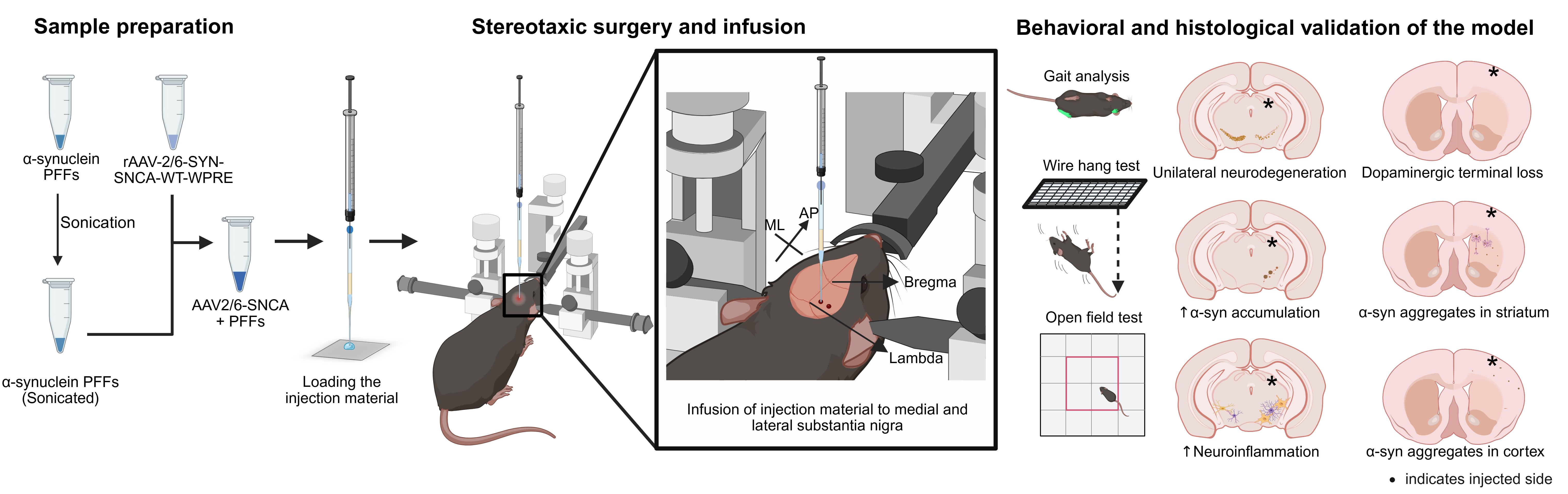
Graphical overview
Background
Parkinson's disease (PD) is a complex neurodegenerative disorder primarily caused by the degeneration of dopaminergic neurons of the substantia nigra (SN) [1]. This loss is accompanied by abnormal aggregation of the α-synuclein protein in several brain areas [2]. Despite extensive research in the field, the mechanisms driving PD remain incompletely understood, and effective disease-modifying therapies are lacking. Preclinical animal models that faithfully recapitulate both the neuropathological and behavioral features of PD are critical for advancing mechanistic insights and therapeutic development. Historically, the most widely used rodent models have been based on neurotoxins such as 6-hydroxydopamine (6-OHDA), 1-methyl-4-phenyl-1,2,3,6-tetrahydropyridine (MPTP), or rotenone. These models produce a relatively rapid and severe loss of dopaminergic neurons accompanied by behavioral deficits but fail to capture the slow, progressive characteristics of human PD and its important pathological hallmarks such as α-synuclein aggregation [3–9]. To overcome these limitations, transgenic and viral vector-based approaches involving various PD-associated genes or their mutations have been developed [10–12]. Recombinant adeno-associated viral (rAAV) vectors expressing human α-synuclein are among the most widely used strategies and can produce progressive neurodegeneration and α-synuclein pathology [13–15]. While rAAV–based approaches offer the advantage of precise targeting of α-synuclein expression to specific brain regions and even particular cell types through the use of cell-selective promoters or tailored AAV serotypes, achieving strong pathological features such as protein aggregation, enhanced neuroinflammation, and profound motor impairments typically requires very high viral titers. This, however, introduces concerns of nonspecific viral toxicity and limits physiological relevance, since such elevated levels of α-synuclein are not observed in sporadic PD patients.
In recent years, several groups have reported injecting a lower titer of rAAVs overexpressing α-synuclein, with additional injection of α-synuclein preformed fibrils (PFFs) either mixed together or in a sequential surgery, in rodents [16–18]. This combinatorial model, also known as the SynFib model, involves the injection of the rAAV-α-synuclein vector and the PFFs into the medial and lateral SN unilaterally (allowing the non-injected side as an internal control). Such injection is at doses that have only a moderate impact when each component is administered individually; however, their combination elicits robust PD–like pathology, including dopaminergic neuron loss, motor impairments, Lewy body–like inclusions, and pronounced neuroinflammatory responses. Here, we present a refined SynFib protocol optimized for mice that achieves progressive α-synuclein pathology through a single stereotaxic injection. In addition, the use of pulled glass capillaries for delivery minimizes tissue damage, reduces procedure-related neuroinflammatory artifacts, and prevents backflow of injected material. This approach enhances reproducibility, reduces surgical complications, and increases its translational value.
Materials and reagents
Biological materials
1. The rAAV2/6 overexpressing human α-synuclein under Synapsin-1 promoter (rAAV2/6-SYN-SNCA(WT)-WPRE-pA) was prepared and purified at Cell and Gene Technologies Core, Lund University (Lund, Sweden) and was a kind gift from Dr Malin Parmar (titer: 1.2 × 10¹⁴ gc/mL). This vector was used to carry out the procedures mentioned in this protocol. A similar overexpression system [rAAV-CMV-SYN-SNCA(WT)-WPRE-bGHpA] is also available commercially from BrainVTA (catalog number: GT-0070) (Wuhan, China).
2. Human α-synuclein pre-formed fibrils (PFFs) at a concentration of 5 μg/μL were generated in the lab of Dr Kelvin C Luk (University of Pennsylvania, Perelman School of Medicine, Philadelphia, United States) using a previously described methodology [19]. Similar PFFs are also available from commercial sources like StressMarq Biosciences (catalog number: SPR-322) and ACROBiosystems (catalog number: ALN-H5115).
Reagents
1. Isoflurane I.P. (Sosrane, Neon Laboratories Limited, DrugBank Accession Number: DB00753)
2. Absolute ethanol (Merck, catalog number: 100983)
3. Hydrogen peroxide (Himedia, catalog number: PTC1511)
4. Sodium chloride (Merck, catalog number: 1.93206.0521)
5. Milli-Q water (Millipore)
Solutions
1. Saline (0.9%) (see Recipes)
2. Ethanol (70%) (see Recipes)
3. Hydrogen peroxide solution (4%) (see Recipes)
Recipes
Note: All the solutions are recommended to be prepared fresh (preferably a day before the surgery) and should be at room temperature at the time of usage. The hydrogen peroxide solution must be protected from light by storing it in an amber colored tube and should be stored at 4 °C until the day of the surgery.
1. Saline (0.9%)
| Reagent | Final concentration | Quantity or volume |
|---|---|---|
| Sodium chloride | 0.9% | 180 mg |
| Milli-Q water | 99.1% | Volume made up to 20 mL |
| Total | 20 mL |
Autoclave the above solution.
2. Ethanol (70%)
| Reagent | Final concentration | Quantity or volume |
|---|---|---|
| Absolute ethanol | 70% | 35 mL |
| Milli-Q water | 30% | 15 mL |
| Total | 50 mL |
3. Hydrogen peroxide solution (4%)
| Reagent | Final concentration | Quantity or volume |
|---|---|---|
| Hydrogen peroxide (30%) | 4% | 6.67 mL |
| Milli-Q water | 96% | 43.33 mL |
| Total | 50 mL |
Laboratory supplies
1. Glass capillaries GC150TF-10 (Harvard Apparatus, catalog number: EC1 30-0066: 1.5 mm outer diameter, 1.17 mm inner diameter, 100 mm length)
2. Single-use 1 mL syringes [DispoVan, 26G × 1/2 (0.45 × 13 mm)]
3. Hamilton syringe (Hamilton, catalog number: CAL87930/00, SYR 75RN 5 μL, calibrated)
4. Sterile cotton swabs (Q-tips)
5. GenTeal sterile lubricant eye gel (Alcon, 10 g)
6. Lignocaine hydrochloride gel (Neon, 30 g)
7. Surgical blades (Lister, Number 10)
8. Dressing forceps curved (Aesculap, catalog number: BD313R)
9. Durogrip needle holder (Aesculap, catalog number: BM127R)
10. Fine forceps standard (Dumont, catalog number: 11251-35)
11. Operating scissors (RWD, catalog number: S-14016-13)
12. Infrared lamp (Beurer wellbeing, model: IL11)
13. Suture (Suture planet, catalog number: SP 3317, 3/8 circle reverse cutting, USP 5-0, 12 mm)
14. Mineral oil (B-loyal, pack size: 100 mL)
15. Neosporin antibiotic powder (GSK, pack size: 10 g)
16. MicroFil Flexible Needle 28G (World Precision Instruments, MF 28G67-5)
17. Ultra-fine marker (Sharpie, catalog number: 37161PP, 0.3 mm size)
Equipment
1. Power sonic bath sonicator (HWASHIN, model: Powersonic 410)
2. Pipette puller (Narishige, model: PC-100)
3. Digital lab standard with mouse and neonatal adaptor (Stoelting, catalog number: 51925)
4. Micrometer high-speed drill with drill bits (Stoelting, catalog number: 51449)
5. Drill holder (Stoelting, catalog number: 51630)
6. Mouse ear bars (Stoelting, catalog number: 51511W)
7. Quintessential stereotaxic injector (QSI) (Stoelting, catalog number: 53311)
8. Anesthesia air pump (RWD, model: R510-29)
9. Compact small animal anesthesia machine (RWD, catalog number: R500)
10. Gas evacuation apparatus (RWD, catalog number: R546-Pro)
11. Gas filter canister (RWD, catalog number: R510-31)
12. Stereomicroscope (Leica Microsystems, catalog number: S9E)
13. Mountable focus arm for “S” series stereomicroscope (Leica Microsystems, catalog number: 10447255)
14. Flexarm stand with table clamp for stereomicroscope (Leica Microsystems, catalog number: 10450495)
15. SurgiSuite multi-functional surgical platform for mice and rats with warming (Kent Scientific, catalog number: SURGI-M04)
16. Glue gun (Bristo-Generic, model: HL-E-20W)
Procedure
登录/注册后免费查看全文
文章信息
稿件历史记录
提交日期: Sep 15, 2025
接收日期: Oct 28, 2025
在线发布日期: Nov 6, 2025
出版日期: Dec 5, 2025
版权信息
© 2025 The Author(s); This is an open access article under the CC BY-NC license (https://creativecommons.org/licenses/by-nc/4.0/).
如何引用
Subramanya, S. K., Singh, D. and Thakur, P. (2025). A One-Step Mouse Model of Parkinson’s Disease Combining rAAV-α-Synuclein and Preformed Fibrils of α-Synuclein. Bio-protocol 15(23): e5525. DOI: 10.21769/BioProtoc.5525.

 Download Citation in RIS Format
分类
神经科学 > 神经系统疾病 > 帕金森氏症
神经科学 > 神经系统疾病 > 动物模型
您对这篇实验方案有问题吗?
在此处发布您的问题,我们将邀请本文作者来回答。同时,我们会将您的问题发布到Bio-protocol Exchange,以便寻求社区成员的帮助。
 发布问题
发布问题


