


Grafting of Potato Plants
马铃薯嫁接实验

发布: 2012年12月05日第2卷第23期 DOI: 10.21769/BioProtoc.303 浏览次数: 12459
 PDF
PDF  Q&A
Q&A
参见作者原研究论文
The authors used this protocol in:
May 2012
Advertisement







Abstract
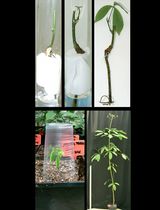
Grafting is a very useful technique for testing the transmission of long-distance signals in plants and is used in agriculture and gardening for different purposes. This protocol, based on a previously published one (Jackson et al., 1998), describes a grafting method for potato plants, which has successfully been used to test the transmission of tuber-inducing signals (Martin et al., 2009; González-Schain et al., 2012). We describe first the procedures for plant growth and then the grafting procedure. Although this method has been used for grafting plants that were initially grown in vitro, it should work as well with plants grown from tubers in soil. This protocol probably works well for other plant species, with small modifications.
Keywords: Grafting (嫁接) Potato (马铃薯)
Solanum tuberosum (马铃薯)
Potato (马铃薯)
Solanum tuberosum (马铃薯)
Materials and Reagents
- Murashige & Skoog medium including vitamins (Duchefa Biochemie, catalog number: M0222 )
- Sucrose
- MES (Sigma-Aldrich, catalog number: M8250 )
- ddH2O
- KOH
- GelriteTM (Duchefa Biochemie, catalog number: G1101.5000 )
- Soil composed of blocking compost (Plantaflor® Presstopfsubstrat) and sand in a 3:1 proportion
- KNO3
- NH4NO3
- K2HPO4
- KH2PO4
- Ca(NO3)2.4H2O
- MgSO42.7H2O
- FeSO42.7H2O
- Kelamix
- Fertilization solution: modified Hoagland’s solution (Johnson et al., 1957) diluted 1/60 (see Recipes)
- 2MS medium (see Recipes)
Equipment
- Plant growth chamber
- Laminar flow hood
- Sterile forceps
- Glass jars, glass tubes or plastic containers suitable for in vitro growth
Note: Equipments 1-4 is not required if plants are grown from tubers in soil.
- Sterile scalpels
- Pots
- Stakes
- Plant twist ties (e.g. Garden Odyssey, catalog number: T001 )
- Beaker
- Paper surgical tape (e.g. 3 M Micropore medical tape, catalog number: 1530-0 )
- Transparent plastic bags
- Adhesive tape
Procedure
登录/注册后免费查看全文
文章信息
版权信息
© 2012 The Authors; exclusive licensee Bio-protocol LLC.
如何引用
Suárez-López, P. (2012). Grafting of Potato Plants. Bio-protocol 2(23): e303. DOI: 10.21769/BioProtoc.303.

 Download Citation in RIS Format
分类
植物科学 > 植物生理学 > 植物生长
植物科学 > 植物发育生物学 > 综合
您对这篇实验方案有问题吗?
在此处发布您的问题,我们将邀请本文作者来回答。同时,我们会将您的问题发布到Bio-protocol Exchange,以便寻求社区成员的帮助。
 发布问题
发布问题


