


- Protocols

- Articles and Issues
- For Authors
- About
- Become a Reviewer


Iron - Prussian Blue Reaction - Mallory’s Method

Published: Vol 2, Iss 13, Jul 5, 2012 DOI: 10.21769/BioProtoc.222 Views: 27084
 PDF
PDF  Ask a question
Advertisement


Protocol Collections
Comprehensive collections of detailed, peer-reviewed protocols focusing on specific topics



Related protocols
Abstract
Purpose: To demonstrate ferric iron in tissue sections. Small amounts of iron are found normally in spleen and bone marrow. Excessive amounts are present in hemochromatosis, with deposits found in the liver and pancreas, hemosiderosis, with deposits in the liver, spleen, and lymph nodes.
Principle: The reaction occurs with the treatment of sections in acid solutions of ferrocyanides. Any ferric ion (+3) in the tissue combines with the ferrocyanide and results in the formation of a bright blue pigment called 'Prussian blue" or ferric ferrocyanide.
Materials and Reagents
- Control: A known positive control tissue (such as spleen)
- Formalin
- EtOH
- Hydrochloric acid
- Aluminum sulfate
- Histoclear reagent
- Mounting solution
- Fixative (see Recipes)
- 5 % potassium Ferrocyanide (see Recipes)
- 5% hydrochloric acid (see Recipes)
- Nuclear-fast red (Kernechtrot) (see Recipes)
- Working solution (see Recipes)
Equipment
- Microwave oven
- Acid-cleaned glassware
- Non-metallic forceps.
- Gloves, goggles and lab coat
- Fume hood
Procedure
Safety: Wear gloves, goggles and lab coat. Avoid contact and inhalation. Potassium ferrocyanide; Low toxicity as long as it is not heated, it will release cyanide gas.
Hydrochloric acid; target organ effects on reproductive system and fetal tissue. Irritant to skin eyes and respiratory system.
- Deparaffinize tissue slide and hydrate to distilled water (use Histoclear reagent 2x, 100% EtOH 2x, 95% EtOH 1x, 90% EtOH 1x, 80% EtOH 1x, 70% EtOH 1x, ddH2O 1x. leave 3-5 min in each solution).
- Immediately transfer slides into working solution (avoid drying the tissue) and either use the microwave method (30 sec, then allow slides to stand in solution for 5 min in fume hood) or use the conventional method (room temperature for 30 min).
- Rinse in distilled water.
- Nuclear-fast red (incubate for 5 min at room temperature).
- Wash in tap water (several washes).
- Dehydrate, clear (reverse the order of step 1 above).
- Add mounting solution and coverslip.
- Results:
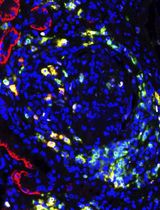
(Slide shows mouse spleen at 400x)Iron (hemosiderin): Blue Nuclei: Red Background: Pink
Representative data

Figure 1. Typical results from this experiment
Recipes
- Fixative
10% formalin - 5% potassium ferrocyanide
Potassium ferrocyanide 25.0 mg
Distilled water 500 ml
Mix well, pour into an acid-cleaned brown bottle.
Stable for 6 months.
Caution: Low toxicity if not heated. - 5% hydrochloric acid
Hydrochloric acid, conc. 25.0 ml
Distilled water 475.0 ml
Mix well, pour into brown bottle.
Stable for 6 months.
Caution: Corrosive, avoid contact and inhalation. - Nuclear-fast red (Kernechtrot)
Aluminum sulfate 25.0 mg
Distilled water 500 ml
Nuclear-fast red 0.5 mg
Dissolve the aluminum sulfate in distilled water, then the nuclearfast red, using heat. Cool, filter, and add a few grains of thymol as a preservative.
Label with date. Stable for 1 year.
Caution: Irritant, avoid contact and inhalation. - Working solution
5% potassium ferrocyanide 25.0 ml
5% hydrochloric acid 25.0 ml
Make fresh, discard after use.
Caution: Avoid contact and inhalation.
Acknowledgments
This protocol was adapted/modified from original versions as described in Luna (1968).
References
- Sheehan, D., Hrapchak, B. (1980). Theory and practice of histotechnology. 2nd ed.; Battelle Press: Ohio, p. 217-218.
- Luna, L. (1968). Manual of histologic staining methods of the AFIP. 3rd ed.; McGraw-Hill: NY. P. 183.
- Crookham, J., Dapson, R. (1991). Hazardous chemicals in the histopathology laboratory. 2nd ed.; Anatech.
Article Information
Copyright
© 2012 The Authors; exclusive licensee Bio-protocol LLC.
How to cite
Jouihan, H. (2012). Iron - Prussian Blue Reaction - Mallory’s Method. Bio-protocol 2(13): e222. DOI: 10.21769/BioProtoc.222.

 Download Citation in RIS Format
Category
Cell Biology > Tissue analysis > Tissue staining
Cell Biology > Cell staining > Iron
Do you have any questions about this protocol?
Post your question to gather feedback from the community. We will also invite the authors of this article to respond.
 Post a Question


